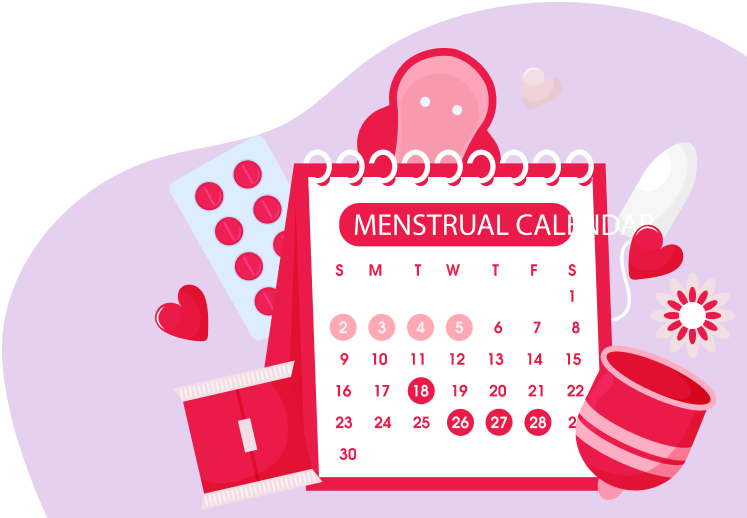
A menstrual cycle is the recurring hormonal process that prepares the body for a possible pregnancy each month, spanning from the first day of one period to the first day of the next (American College of Obstetricians and Gynecologists, 2022). The average cycle lasts 28 days, though a range between 21 and 35 days is considered typical for adults.
The Four Phases
The menstrual phase marks the beginning of the cycle, during which the uterine lining, built up during the previous cycle, is shed as menstrual blood over three to seven days. This phase overlaps with the tail end of the hormonal cycle from the month before, since the drop in progesterone that triggers bleeding also signals the start of the next cycle. The follicular phase runs from the first day of the period until ovulation, though it is measured from day one regardless of overlap with menstruation. During this phase, the pituitary gland releases follicle-stimulating hormone, prompting the ovaries to develop several follicles, each containing an immature egg. One follicle typically becomes dominant, while rising estrogen levels cause the uterine lining to thicken again in preparation for potential implantation.
Ovulation occurs roughly midway through the cycle, when a surge in luteinizing hormone triggers the dominant follicle to release its egg. This event typically happens around day 14 in a 28-day cycle, though timing shifts earlier or later depending on overall cycle length. The luteal phase follows ovulation and lasts, with less variation than the other phases, for roughly 12 to 14 days regardless of total cycle length. The ruptured follicle transforms into a temporary structure called the corpus luteum, which produces progesterone to maintain the uterine lining. If fertilization does not occur, the corpus luteum breaks down, progesterone falls, and the lining sheds, beginning the cycle again.
Hormones Driving the Process
Four hormones coordinate the cycle: follicle-stimulating hormone and luteinizing hormone, both produced by the pituitary gland, alongside estrogen and progesterone, produced primarily by the ovaries. These hormones rise and fall in a coordinated sequence, and disruption at any point, whether from stress, illness, or an underlying condition, can shift cycle length or regularity.
Why Cycle Length Varies
Cycle length differences between individuals, and even between cycles for the same individual, generally stem from variation in the follicular phase rather than the luteal phase. A person whose cycles range from 26 to 34 days is typically experiencing a follicular phase that shortens or lengthens slightly each month, while the luteal phase remains comparatively stable.
When Irregularity Signals a Problem
Cycles shorter than 21 days or longer than 35 days on a consistent basis, or a total absence of periods for three months or more outside of pregnancy, generally warrant medical evaluation. Conditions such as polycystic ovary syndrome, thyroid dysfunction, and significant weight changes can all disrupt the hormonal signals that keep a cycle within a typical range.
Frequently Asked Questions
Quick answers to common questions.
How long does a normal menstrual cycle last?
Cycle length is measured from the first day of one period to the first day of the next, with 21 to 35 days considered a typical range and 28 days representing the statistical average.
Which phase of the cycle varies the most in length?
The follicular phase, which runs from the first day of the period to ovulation, accounts for most of the variation seen between different cycle lengths.
What triggers the shedding of the uterine lining?
A drop in progesterone, occurring when the corpus luteum breaks down without fertilization, removes the hormonal support keeping the lining intact, leading to menstrual bleeding.
Track It in the App
A menstrual cycle is more than a 28-day calendar. Ovulation timing can vary from cycle to cycle.